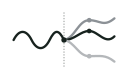
About Consequence Machines
We’re a research-driven team working on models of temporal dynamics and the consequences of actions.
From predicting events to understanding actions.
Many important decisions involve a system that changes over time: adjusting an operating setting, changing a configuration or choosing when to intervene.
We’re building models intended to learn from the history of a system and explore how different actions could shape its future.
Our ambition is a reusable foundation for this kind of reasoning across temporal systems—not a separate modeling project for every new application.
Broad foundations. Specific tests.
Our work combines synthetic pretraining, time-series modeling and action-conditioned prediction.
Synthetic systems let us vary mechanisms, actions and operating conditions deliberately. Real-world data then tests whether what the model has learned transfers beyond those generated environments.
We distinguish what the evidence supports from what remains a hypothesis. Prediction quality, uncertainty and the usefulness of a decision all need to be evaluated—not assumed.
How we’ll know it works.
The primary measure is how much plant-specific data and engineering a model needs to match a strong per-system model. We compare against fitted models, system identification and existing methods, not weak baselines alone. Every model we compare receives the same history, and we report improvement over a stated baseline, even when it is small.
We also check decision quality, reliability and failure cases, and report them even when they are unfavourable. Where the evidence does not yet support a claim, we say it is still a hypothesis.
Ask what would happen before you act.
The long-term aim is a model of a physical system that answers what-if questions: what happens if we change this setting, schedule or input, and how far should we trust the answer?
“Psychohistory” is a fictional science from Isaac Asimov’s Foundation series, where it forecasts whole societies and steers them toward an optimal future. We are not building that. Physical systems are measurable, but their futures depend on interventions, noise and changing conditions, and no model is complete. What can be built is narrower: a model that compares candidate actions against a stated goal, and reports where its evidence stops.
We will move forward one gate at a time:
- Show how a model responds to actions on real systems, against strong baselines.
- Adapt it to a new system from that system’s own history, with less local data than a per-system model needs.
- Extend it across sensor-rich domains such as energy, manufacturing and infrastructure, with evidence in each.
We do not claim optimal control, autonomous operation or a general solution to hidden confounding. If the evidence does not support a step, we stop there and say so.
Founded by a time-series researcher.
Consequence Machines was founded by Vladyslav Moroshan, first author of TempoPFN (NeurIPS 2026), a time-series foundation model pretrained only on synthetic data.
Build the evidence with us.
We’re interested in thoughtful collaborations with evaluation partners and researchers who can help test these ideas on meaningful systems and decisions.
Work with us