Understand what happens when you act.
We’re building temporal world models: models that learn how sensor data and multivariate time series evolve, and how actions change what happens next. Our goal is to let operators test an action on a model of their system before they take it on the real one, with less plant-specific data and setup than today.
They answer what-if questions: what would happen under each option, such as a heating schedule or a process setpoint, before committing to one.
Early research prototype. Looking for evaluation partners and research collaborators.
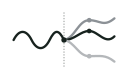
Dark line: observed history. Grey rows: observed covariates 1 to 3 (covariate 3 is static). Dotted line: now. Right: where each option ends, ranked by distance to the target band. Filled marker: the selected option. Bottom line: the action taken.
A forecast says what happens. A what-if says what happens if we act.
Forecast
What will the load be tomorrow?
Predicts how the system evolves if nothing changes. Useful for planning, but it cannot rank the choices you actually have.
What-if
What happens if we charge the battery now, or after the evening peak?
Predicts how the system would respond to each option, then compares those futures against the target, with uncertainty shown.
Two limits of today’s approaches:
Each system needs its own model.
Every plant, building or process family is modelled separately, and the model is rebuilt when equipment or operating conditions change.
Logs show only one outcome.
Operations record what happened under the action that was taken, for reasons the data does not show. The alternatives were never tried.
The future depends on what you do.
Consequence Machines learns from observed histories, operating context and recorded actions. Our models use them to show how a system would respond to each option, compare those responses and make uncertainty visible.
Example: compare two battery-charging schedules against a cost and comfort target. Recommendations are for an engineer to review. There is no autonomous control.
Learn the dynamics. Adapt to the system.
We pretrain on diverse synthetic dynamical systems. There, the effect of every action is known, which real logs can never show. We then test whether that experience helps a model understand a new system from its history.
The hypothesis is simple: useful knowledge about dynamics should be reusable, rather than rebuilt from scratch for every application. We aim to reduce the plant-specific data and engineering needed to evaluate what an action would do.
This is a hypothesis we are testing, not a result we have shown. Research in progress, focused on rigorous evaluation and real-world validation.
One model, three questions.
Every operator asks the same three questions: what will happen next, will something go wrong, and what would this action change? A model that understands how a system responds to actions can answer all three.
Energy and storage
When should the battery charge, and when should it discharge?
Compare charging and discharge schedules against cost, grid constraints and comfort, before one is scheduled.
Manufacturing
Which setpoint reaches the target without losing quality?
Compare process settings on sensor history before changing the line.
Cloud and data centres
What will a planned scaling change do to latency and cost?
Simulate a change before it is deployed, and flag likely failures early. This domain is exploratory: we have not yet tested it on cloud data.
Each step has to earn the next.
Step 01
Predict.
Forecast how the system responds, measured against strong baselines.
Step 02
Compare actions.
Score candidate actions against a stated goal, with uncertainty shown.
Step 03
Recommend for review.
An engineer reviews every recommendation. This is our first deployment target.
Step 04
Automate, only if proven.
Closed-loop control is not part of the current research. It would need separate evidence and safety work.
An early prototype, being tested on real measurements.
Built
A generator of causal multivariate time series, and a model trained from scratch to predict the consequences of actions on it.
Testing
Early tests on semi-synthetic and real measurements from a physical testbed, where interventions have known outcomes.
Not yet shown
Transfer to a customer’s system, and willingness to pay.
Two ways to get involved.
For evaluation partners
You have one recurring operational decision and an engineer who can help define a fair test. Most useful to us:
- Records of what was done and what happened next, with timestamps.
- A named owner for the decision.
We run a bounded feasibility study against your current approach, with clear stop criteria. Recommendations go to your engineers for review.
For researchers and collaborators
We’re developing the model and its evaluation in the open: synthetic priors for dynamical systems, evaluation protocols for action-response prediction, and benchmarks.
If you work on time series, causal inference or world models, tell us where you’d like to help.
What decision does your system need to make?
We’d like to hear from teams with a recurring decision and time-series data, and from researchers working on temporal models.
Tell us whether you’re an evaluation partner or a researcher, and what you’re exploring.